If you are a heavier man starting to walk more, shoes matter.
Not because you need some special category of “plus-size footwear”, but because every step puts more load through the shoe. A model that feels soft and comfortable in a shop can become unstable, compressed or simply uncomfortable once you start walking several kilometres at a time.
The good news is that there are plenty of excellent options available. You do not need the most expensive pair, and you do not necessarily need a dedicated walking shoe either. Many well-cushioned running shoes work extremely well for walking.
This guide looks at five models I would seriously consider for a heavier man starting to walk regularly.
They are not ranked from best to worst. They solve slightly different problems.
Disclosure: This article contains Amazon affiliate links. If you buy through one of these links, I may earn a commission at no extra cost to you. As an Amazon Associate I earn from qualifying purchases.
Quick comparison
| Shoe | Best for |
|---|---|
| HOKA Bondi 9 | Maximum cushioning and everyday walking |
| New Balance Fresh Foam 680v9 | Budget-conscious beginners |
| Brooks Ghost Max 3 | Cushioned walking with a smooth rocker |
| Saucony Echelon 10 | Wide feet and a broad, stable platform |
| ASICS GEL-KAYANO 33 | Extra support and stability |
The most important thing is still fit. A technically excellent shoe in the wrong width is a bad shoe for you.
1. HOKA Bondi 9 — Best all-round option for maximum cushioning
Personally tested
The HOKA Bondi 9 is the shoe on this list I can speak about from direct experience.
I have been using my pair for close to a year and currently walk roughly 3–15 km per week in them. They still feel very good, the cushioning has held up well, and I have not noticed the shoe becoming noticeably flat or uncomfortable over time.
I originally tried the regular-width version, but it was simply too tight for my feet. I switched to the Extra Wide version and that made a major difference. The fit is now excellent and gives my foot enough room without feeling loose or unstable.
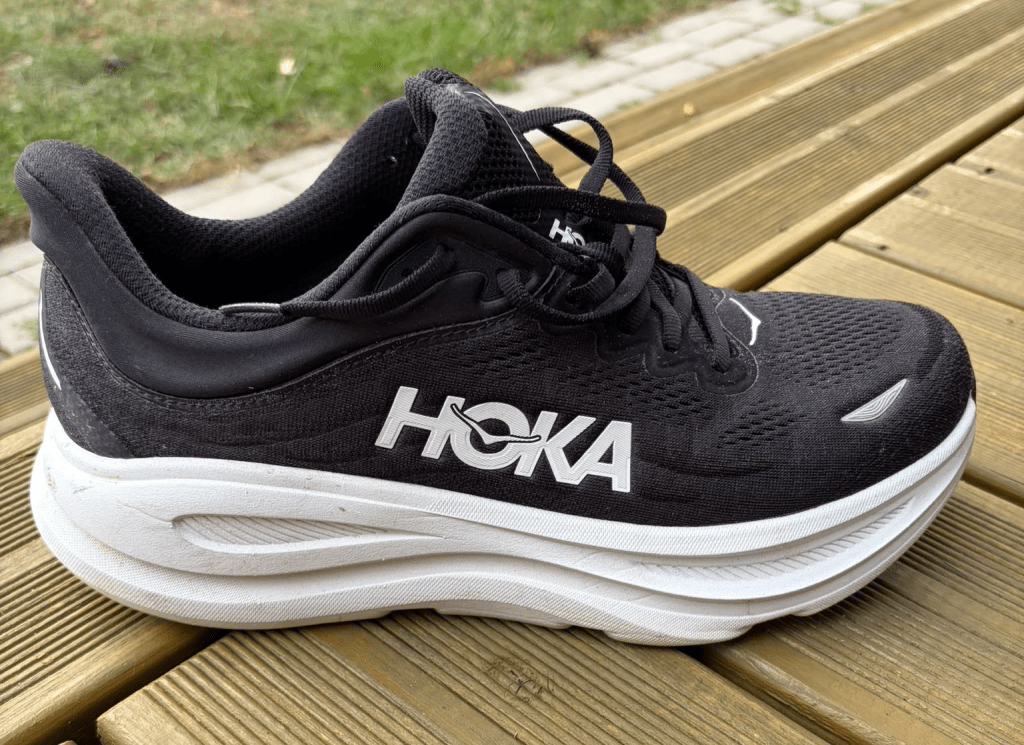
My own HOKA Bondi 9 Extra Wide after close to a year of regular walking.
What I like
The main strength is the cushioning.
For walking on asphalt and pavement, the Bondi 9 feels very protective underfoot. The shoe absorbs a lot of the impact without feeling unstable, and for a heavier walker that is exactly what I want from an everyday walking shoe.
The broad platform also helps. Despite the amount of foam, I do not get the feeling that I am balancing on a narrow or excessively soft sole.
After close to a year of use, the shoe still feels comfortable and supportive, which is probably the strongest endorsement I can give it.
The drawback
They are not attractive shoes.
The Bondi 9 is large, bulky and very obviously built around cushioning rather than elegance. I would happily wear them for walking or training, but I would not choose them as everyday casual shoes.
That may sound superficial, but it matters if you want one pair that works both for exercise and normal daily use.
Best for
- Heavier walkers prioritising cushioning
- Pavement and asphalt
- Regular walking
- People who need wide or extra-wide sizing
- Anyone who values comfort more than appearance
My take: This is the strongest recommendation on the list because it is the one I actually use. The Extra Wide version fits me very well, the cushioning is excellent, and after close to a year the shoes still feel great. The only real negative is that they are bulky and ugly enough that I personally would not wear them outside training.
2. New Balance Fresh Foam 680v8 — Best budget option
The New Balance Fresh Foam 680v8 is an older model, but that is actually part of why it makes sense here.
You do not need the newest generation of a shoe just to start walking. If the previous model is still widely available and costs noticeably less, that can be a very sensible buy.
The 680v8 uses New Balance’s Fresh Foam cushioning and gives you the basics most beginners actually need without pushing into premium-shoe pricing.
Why it makes sense for a beginner
Someone starting from almost no regular walking does not necessarily need maximum cushioning, complex stability systems or the newest foam technology.
You need:
- a comfortable fit
- enough cushioning
- decent grip
- sensible width
- a shoe you are actually willing to buy
The 680v8 covers those basics well and keeps the initial investment reasonable.
That matters if you are still figuring out whether walking will become a regular three-times-a-week habit or just something you are trying for a few weeks.
What you give up
This is not a budget version of the Bondi 9.
You should expect less cushioning, less structure and a more basic overall feel than the premium shoes in this guide.
For a very heavy walker, or someone already doing longer distances several times per week, I would be more inclined to spend extra on one of the more protective models.
But for somebody beginning with shorter walks, the 680v8 is exactly the kind of shoe I would consider before assuming you need to spend a lot.
Best for
- Beginners
- Short and moderate walks
- Budget-conscious buyers
- Someone unsure how much they will actually walk
- Anyone who wants a simple, practical first pair
My take: This is the sensible-value choice. It is not the newest model and it is not trying to compete with premium max-cushion shoes. That is fine. If it fits properly and gets you walking consistently without a large upfront cost, it is doing exactly what it needs to do.
3. Brooks Ghost Max 4 — Best for a smooth, protective walking feel — Best for a smooth, protective walking feel
The Brooks Ghost Max 4 sits in an interesting position between a traditional running shoe and the newer generation of maximum-cushion shoes.
It is built around substantial cushioning and a rocker-shaped sole designed to create a smooth heel-to-toe transition.
Why the rocker matters for walking
A rocker-shaped sole curves upward toward the front of the shoe.
Instead of your foot doing all the work to roll from heel strike through to toe-off, the geometry of the shoe helps move you forward.
For some heavier walkers, particularly when tired, that can feel very natural.
It is not magic and it will not fix poor walking mechanics. But for steady pavement walking, a smooth transition can make the shoe feel less demanding.
Why consider it instead of the Bondi
The Ghost Max gives you a lot of protection without necessarily producing exactly the same soft, plush sensation as the Bondi.
Some people prefer that.
Maximum softness is not always the same thing as maximum comfort. If a very soft shoe makes you feel unstable, a slightly more controlled platform may work better.
Possible downside
As with most high-stack shoes, you should make sure you feel stable when turning, stepping off kerbs and walking on uneven surfaces.
If most of your walking is on forest paths or rough gravel rather than pavement, I would look elsewhere.
Best for
- Pavement walking
- People who like substantial cushioning
- Walkers who appreciate a rocker-style sole
- Longer steady walks
- Anyone who wants a protective feel without maximum softness
My take: A very credible alternative to the Bondi, especially if you want a cushioned shoe with a smoother rolling feel.
4. Saucony Echelon 10 — Best for wide feet and a stable base
The Saucony Echelon 10 might be the least famous shoe in this list, but in some ways it is one of the most logical choices for heavier walkers.
Its main strengths are a broad base, roomy fit and stable feel.
Why width is more important than people think
A common mistake is buying a longer shoe because your normal size feels too narrow.
That can create heel movement and put the flex point of the shoe in the wrong place.
A genuine wide or extra-wide shoe solves the actual problem.
For a heavier walker, having your foot properly supported across a broad platform can also feel much more secure than standing on a narrow sole with lots of foam underneath it.
The Echelon’s strength
This is not really the flashy option.
Its selling point is that the basic geometry makes sense:
- broad base
- roomy shape
- substantial cushioning
- wide sizing options
- everyday walking suitability
That is exactly the combination many bigger walkers actually need.
Possible downside
If you have a narrow foot, the Echelon’s accommodating shape may be unnecessary.
It is also not the shoe I would choose because it looks exciting or technologically advanced. This is a practical recommendation.
Best for
- Wide or extra-wide feet
- Bigger walkers who value stability
- Everyday pavement walking
- People who need more interior room
- Anyone who dislikes narrow running shoes
My take: Probably the most underrated shoe in this group for a genuinely big, wide-footed man.
5. ASICS GEL-KAYANO 33 — Best for additional stability and support
The ASICS GEL-KAYANO 33 is the stability-focused option in this list.
It combines a high level of cushioning with more guidance and structure than a typical neutral shoe.
Who should consider it
Not every heavy walker needs a stability shoe.
Body weight alone does not mean you overpronate, and buying highly supportive footwear purely because you are heavy is not a rule I would follow.
However, some walkers simply feel much more comfortable in a shoe that provides additional guidance and structure.
If you have previously found very soft neutral shoes unstable, or you know that your foot tends to roll inward significantly, the Kayano becomes worth trying.
Why it works for this list
The Kayano is not included because you are planning to become a runner.
It is here because a heavier beginner may value:
- cushioning
- a structured platform
- wide sizing options
- controlled movement
- durability for repeated road use
Possible downside
It is another premium shoe.
And if you have a neutral gait and already feel stable in something like the Bondi or Ghost Max, you may be paying for support you do not particularly need.
Best for
- Walkers who prefer a supportive shoe
- People who feel unstable in very soft neutral shoes
- Wide feet
- Longer road walks
- Anyone who already knows stability shoes suit them
My take: Excellent if you actually need the support. Overkill if you do not.
Which one would I choose?
If I were starting from scratch, I would narrow the decision like this:
I want maximum comfort and don’t mind paying more
HOKA Bondi 9
I just want a decent shoe and don’t want to spend a fortune
New Balance Fresh Foam 680v9
I want lots of cushioning but prefer a smooth rocker feel
Brooks Ghost Max 3
I have genuinely wide feet and want a broad, stable shoe
Saucony Echelon 10
I prefer a more supportive, stability-oriented shoe
ASICS GEL-KAYANO 33
There is no universal winner.
The shoe that fits your foot properly will beat the theoretically “best” shoe almost every time.
A note about body weight
One thing I would not do is obsess over whether a manufacturer officially lists a maximum user weight.
What matters more is how the shoe behaves under your weight.
When you try it on:
- Does your foot feel stable?
- Does the foam compress excessively?
- Is the heel secure?
- Do your toes have enough room?
- Does the shoe still feel supportive when you walk rather than just stand?
- Can you imagine wearing it for 30–60 minutes without thinking about your feet?
Those questions matter more than marketing terminology.
Don’t buy five pairs
This article is not intended to convince you that you need a shoe collection.
If you are starting to walk, you need one good pair.
Choose one that fits properly, start with manageable distances and see how your feet and body respond.
Later, if walking becomes a regular part of your week, having two pairs can make sense. But that is a later problem.
The first objective is simply to remove footwear as an excuse or obstacle.
Final thoughts
For heavier men, I think walking shoes should be boring in the best possible way.
You should not be thinking about them every five minutes.
They should fit, cushion the impact, keep you reasonably stable and survive regular use.
That is why these five made the shortlist.
The HOKA Bondi 9 is the premium all-rounder.
The New Balance Fresh Foam 680v9 is the budget option.
The Brooks Ghost Max 3 offers a protective rocker-based ride.
The Saucony Echelon 10 makes particular sense for wide feet.
And the ASICS GEL-KAYANO 33 gives you additional stability if that is what your feet prefer.
You do not need perfect shoes to start walking.
You just need shoes that make walking easier to repeat tomorrow.
Related guides
If you want to narrow the choice further, these may help:

