I bought my HOKA Bondi 9 Wide in September 2025. Fourteen months later, they are still my preferred shoes for walking, and if I needed to replace them tomorrow, I would buy the same model again without hesitation.
That does not mean they are perfect. They are bulky, relatively expensive and not particularly attractive. They are also not the shoes I would choose for every type of terrain. But for what I actually need as a heavier walker with wide feet, they have been an excellent purchase.
Disclosure: This article contains Amazon affiliate links. If you buy through one of these links, I may earn a commission at no extra cost to you. As an Amazon Associate I earn from qualifying purchases.
My experience at a glance
- Model: Men’s HOKA Bondi 9 Wide (2E)
- Purchased: September 2025 (14 months of ownership)
- My height: 195 cm (6 ft 5 in)
- Size: EU 44⅔ / US 10.5 / UK 10
- Typical weekly walking distance: 3–15 km (2–9 miles)
- Main surfaces: Asphalt, gravel and easy forest paths
- Noticeable loss of cushioning: None
- Would I buy them again? Yes
This review is based on walking rather than running. I have not measured the total distance covered in these shoes or carried out laboratory tests on their cushioning. What I can describe is how they have fitted, performed and held up during regular use over more than a year.
Getting the right size was the biggest challenge
I normally wear around EU 43, and although my feet are fairly wide, I can generally find standard-width shoes that fit comfortably. The Bondi 9 was different.
I initially tried the regular-width version and found it too tight. My first instinct was to go up in size, but increasing the length did not solve the problem. The shoe still felt too narrow, particularly through the middle and front of my foot.
Eventually, I switched to the Wide version in EU 44⅔, and the difference was immediate. My feet had enough room without the shoes feeling loose or insecure.

The size label inside my shoes confirms that this is the Wide (2E) version, not Extra Wide. Although I ultimately ended up wearing a larger size than my usual EU 43, increasing the length alone had not solved the problem. Switching to the Wide version was what made the difference.
I would not recommend automatically buying the Bondi 9 a size or two larger than your normal shoes based on my experience. Foot shape varies, and what worked for me may not work for you. However, if the regular version feels too tight, I would strongly recommend trying the Wide version before simply increasing the length.
I have written more about this in my guide to wide walking shoes versus sizing up.
Cushioning and stability after 14 months
The main reason I like the Bondi 9 is the combination of cushioning and stability. As a heavier walker, I appreciate a shoe that provides substantial cushioning on hard surfaces. But I also want my foot to feel securely supported rather than moving around inside the shoe.
The Bondi achieves that balance very well for me. Despite the large amount of cushioning, the broad sole provides a stable platform, and the Wide upper gives my feet the space they need.
What has impressed me most is that, after 14 months, I have not noticed any meaningful deterioration in cushioning, stability or comfort. The shoes still feel great when I put them on, and I have no particular reason to replace them.
My previous pair of Skechers started to feel noticeably less cushioned after around a year of use. Fourteen months into using the Bondi 9, I have not experienced the same deterioration.
How they perform on different walking surfaces
Most of my walking takes place on a mixture of asphalt, gravel roads and relatively easy forest paths. Depending on the route, I can spend most of a walk on pavement or switch between several different surfaces.
Asphalt and pavement
This is where I think the Bondi 9 makes the most sense. The cushioning feels protective underfoot, and I find the shoes comfortable for both shorter sessions and longer, steady walks.
They are particularly well suited to the kind of walking I do when I want to maintain a consistent pace for 40–60 minutes.
Gravel roads and forest paths
Although the Bondi 9 is a road running shoe, I have found it perfectly usable on packed gravel and uncomplicated forest paths. On one family outing, I walked around 20,000 steps, almost entirely on gravel and forest trails, wearing these shoes. I was comfortable using them throughout the day.
Wet or muddy surfaces are a different matter. I have experienced some slipping in those conditions and tend to slow down when the ground becomes uneven or slippery.
I have never owned dedicated trail running shoes, so I cannot offer a direct comparison. However, for my usual walking routes, I have not felt a need to buy a separate pair.
Durability: what the shoes actually look like today
Rather than showing manufacturer photographs of a brand-new pair, I have included pictures of my own shoes as they look after 14 months of use.
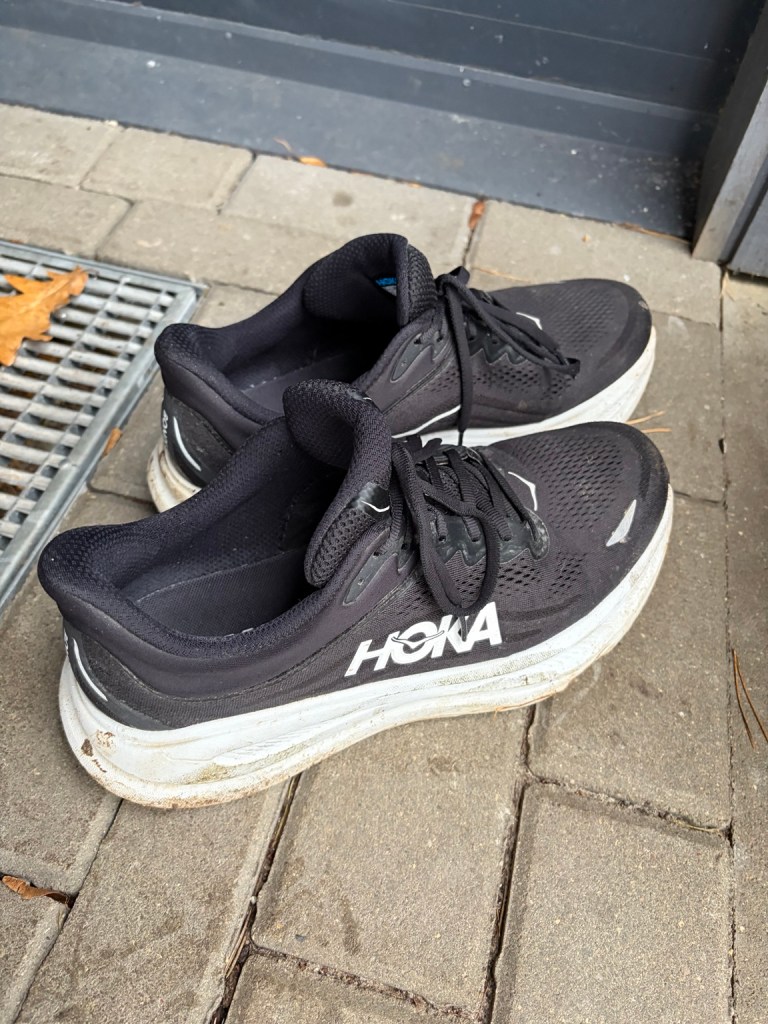
They are certainly no longer new. The white midsoles are marked and dirty, and there are visible creases and signs of wear. However, the uppers still appear to be in good condition, and I have not noticed any significant structural problems.
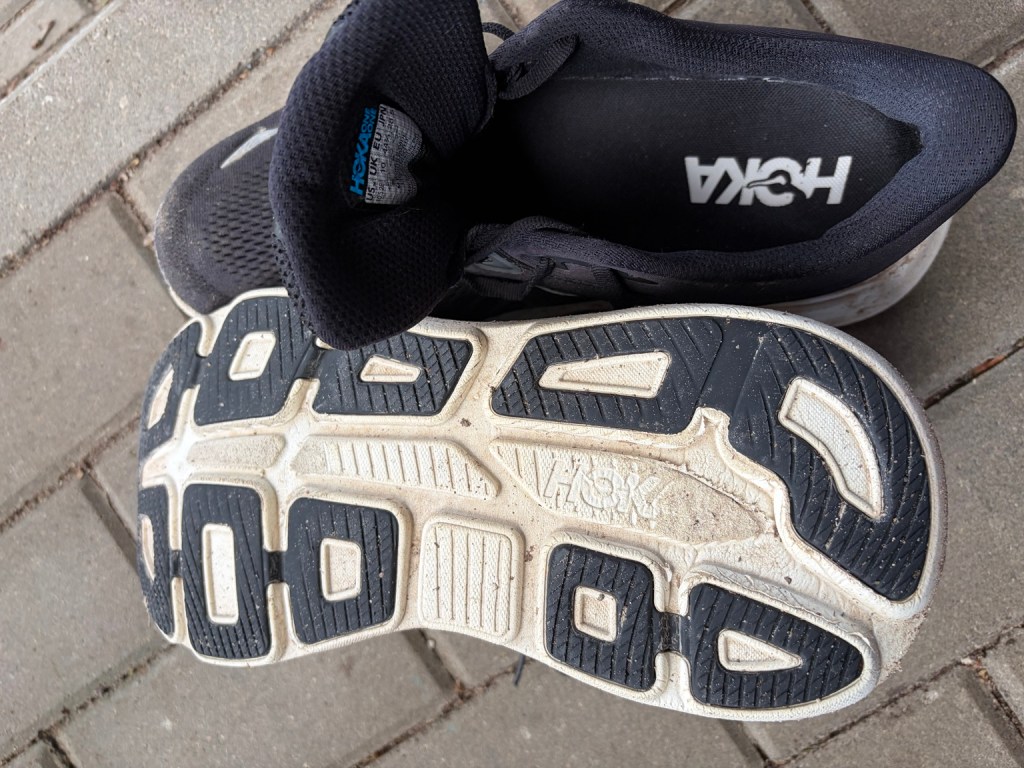
The outsole shows some wear, but much of the original rubber tread pattern remains visible. There is also abrasion on the exposed foam between the rubber sections.
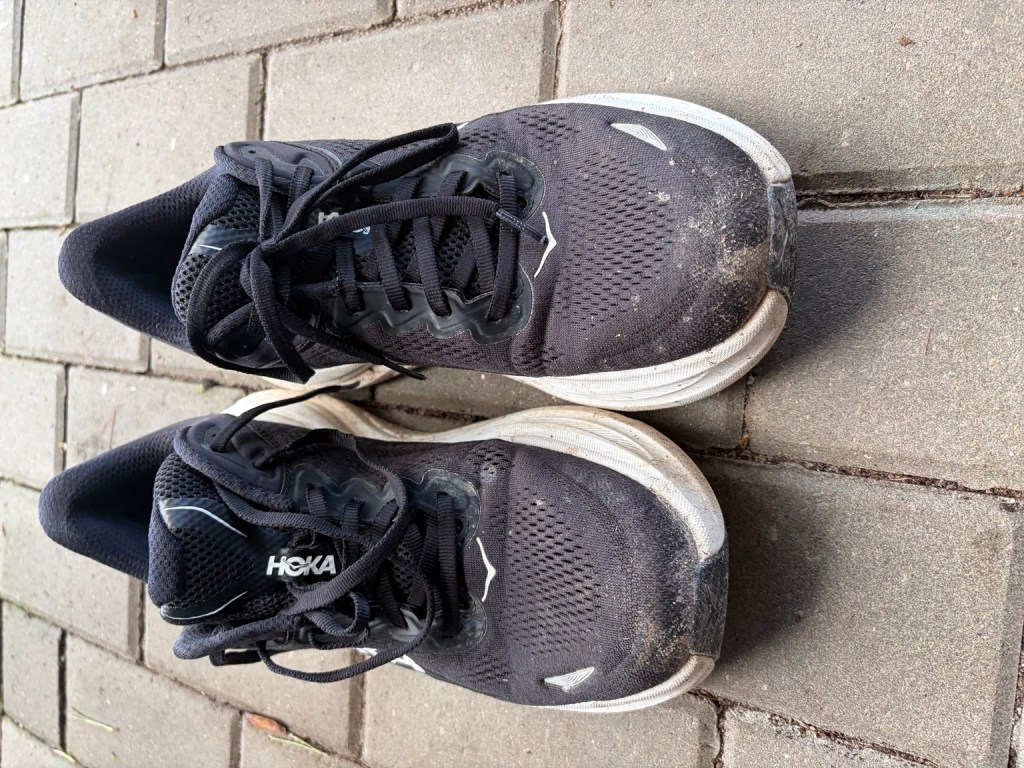
For me, the most important question is not whether the shoes still look new, but whether they continue to perform as I need them to. So far, they do.
My weekly walking distance has varied considerably, so I would not use my 14 months of ownership as a universal lifespan recommendation. Someone walking 40 km (25 miles) every week will put substantially more mileage into their shoes than I do.
What I don’t like about the Bondi 9
My biggest criticism is their appearance. The Bondi 9 is a large, bulky shoe, and even in a relatively discreet black-and-white colour combination, it looks very much like exercise footwear.
I am perfectly happy wearing them for walking, but I would not choose them as casual shoes to wear with jeans at work or when going out. If you want one versatile pair for both exercise and smarter everyday use, these would not be my first recommendation.
The price is another consideration. If you are just beginning to walk regularly and are unsure whether it will become a lasting habit, you do not necessarily need to spend this much on your first pair of shoes.
Who should consider the HOKA Bondi 9 Wide?
Based on my experience, I think they are particularly worth trying if you:
- Are a heavier walker who values substantial cushioning.
- Have wide feet and struggle with narrow running shoes.
- Walk regularly on pavement, gravel roads or easy forest paths.
- Prefer a broad, stable platform underneath your foot.
- Value walking comfort more than appearance.
I would be less inclined to recommend them to someone who primarily walks on muddy or technical trails, wants a discreet casual shoe, or is looking for an inexpensive first pair.
Would I buy the HOKA Bondi 9 Wide again?
Absolutely. When I buy my next pair of walking shoes, the Bondi 9 Wide will be the model that any alternative needs to compete with.
They fit my feet properly, remain comfortable over longer distances and have held up well through 14 months of regular use. I have not experienced any noticeable decline in performance that would make me consider replacing them today.
They are not the best-looking shoes I own, but they are the shoes I reach for when I want to go for a proper walk. For me, that is what matters.
[Check the HOKA Bondi 9 price on Amazon]
If you need the Wide version, make sure to select Wide (2E) before ordering. Amazon may default to the standard width.

